Thursday, April 25, 2013

Earth Day

Earth Day 


Earth Day is an annual day when events are held worldwide to show support for environmental protection. Earth Day is observed on April 22 each year


  • Here are some ideas related to dental care on how to conserve:

    1. Turn off the water while brushing your teeth to help save approximately 25 gallons of water a month.

    2. Recycle your plastic mouthwash bottles.

    3. Find ways to recycle an old tooth brush

    4. Try a toothbrush made from recycled or renewable materials and recycle it when it’s time for a new one.

    5. Use natural toothpaste such as Tom's of Maine

Friday, April 19, 2013

8 Tooth Brush Ideas

8 Toothbrushes Ideas


The ADA recommends changing your toothbrush every 3 months. Here are some nifty ideas to reuse all those  toothbrushes.

After disinfecting the tooth brush with soap and water you can


  1. Use it to clean crevices and hard to reach areas such as a keyboard and windows.
  2. For a really good clean, use a toothbrush to clean around faucets and grout between tiles.
  3. It is useful for scrubbing old shoes, just use a little soap and warter.
  4. With some extra help from tooth paste, you can shine up jewelry such as silver and gold.
  5. You can spot clean dirty laundry and upholstry.
  6. You can use it to clean your fingernails
  7. If you have messy toddlers you can use a tooth brush and tooth paste to get crayon marks off the wall!
  8. Use a toothbrush as a make up tool to control unruly eyebrows.


Just remember to use a different toothbrush for each idea!

Wednesday, April 10, 2013

How to Get Soft Lips

How to Get Soft Lips


Step 1: Lock in Moisture
"The skin on your lips is thin and contains less natural pigment, so it's more susceptible to sun damage and dryness," says Rein Welch, M.D., a dermatoligist and Denver Dermatology Consulatants. Keep that smacker supple by locking in mosture as soon as you step out of the shower. Take a warm, moist washcloth and press it against your mouth for a full minute to saturate lops before the next step, exfoliation.

Step 2: Gently Exfoliate

Once a week, squeeze a pea-sized amount of lip balm (Like Blistex Lip Ointment, $2, at drugstores) into your hand and combine it with equal amounts of granulated sugar, With a clean finger, scrub the mix onto your lips, using a circular motion, for one minute. "The sugar is therapeutic and removes the cracking," says Charles Zugerman M.D., associate professor of dermatology at Northwestern University's Feinberg School of Medicine. For a Premade fix, try Green by Nature Lip Scrub in Mint Green Tea ($4, greenbynaturebeauty.com).

Step 3: Boost Moisture

To amp up hydration and lock in moisture at night, apply a lip salve containing shea butter or petroleum jelly, Such as EOS Lip Balm SmoothSphere ($3, evolutionofsmooth.com) or Urban Rituelle Lip Balm ($8, b-glowing.com) "these heavy emollients createa watertight seal on the lips' surface, protection against moisture loss," Welch says.

Step 4: Apply Protection

The sun can fry your lips, especially if you wear light-attracting glosses. Experts suggest swiping on a balm with an SPF of 15 or higher every day. One to try: Softlips Lip Protectant/Sunscreen SPF 20 ($4 for two, drugstore.com). "Wearing adequate sun protection gaurds against cancer causing UVB rays," Zugerman says. It also slows collagen loss and the development of vertical wrinkles and prevents scaliness.

Step 5: Smooth on Color

Since you're already wearing a barrier lip balm, you can use any lipstick you like. If your lipstick has a sunscreen (try Neutrogena Cosmetices MoistureShine Lipstick SPF 20, $10, drugstore.com), Zugerman says, you can skip Step 4 if you want. To make your color last, follow up by pressing a tissure over your lips and patting on translucent powder. A tiny amount of powder will filter through the tissure, sealing in the color.


Article From Womens Health Magazine

Thursday, April 4, 2013

April is Autism Awareness Month

Shop Charities 

Help Spread Autism Awareness by Supporting these Charities during Autism awareness month


Autism Speaks


Cure Autism Now


 Autism Society of America


Wednesday, March 20, 2013

Oral Health: The Mouth-Body Connection

Oral Health: The Mouth-Body Connection
 

It's easy to ignore the effects of poor oral hygiene because they're hidden in your mouth. But gum disease may point to problems with diabetes and heart disease and loose teeth could be a sign of osteoporosis. Could it be that a healthy mouth means more than just a sparkling smile? And what could your dentist learn about you the next time you open wide?
Your Mouth, the Gateway to Your Body
To understand how the mouth can affect the body, it helps to understand what can go wrong in the first place. Bacteria builds up on teeth make gums prone to infection. The immune system moves in to attack the infection and the gums become inflamed. The inflammation continues unless the infection is brought under control.
Over time, inflammation and the chemicals it releases eat away at the gums and bone structure that hold teeth in place. The result is severe gum disease, known as periodontitis. Inflammation can also cause problems in the rest of the body.
Oral Health and Diabetes
The working relationship between diabetes and periodontitis may be the strongest of all the connections between the mouth and body. Inflammation that starts in the mouth seems to weaken the body’s ability to control blood sugar. People with diabetes have trouble processing sugar because of a lack of insulin, the hormone that converts sugar into energy.
"Periodontal disease further complicates diabetes because the inflammation impairs the body’s ability to utilize insulin," says Pamela McClain, DDS, president of the American Academy of Periodontology. To further complicate matters, diabetes and periodontitis have a two-way relationship. High blood sugar provides ideal conditions for infection to grow, including gum infections. Fortunately you can use the gum disease-diabetes relationship to your favor: managing one can help bring the other under control.
Oral Health and Heart Disease
Though the reasons are not fully understood, it’s clear that gum disease and heart disease often go hand in hand. Up to 91% of patients with heart disease have periodontitis, compared to 66% of people with no heart disease. The two conditions have several risk factors in common, such as smoking, unhealthy diet, and excess weight. And some suspect that periodontitis has a direct role in raising the risk for heart disease as well.
"The theory is that inflammation in the mouth causes inflammation in the blood vessels," says Cram. This can increase the risk for heart attack in a number of ways. Inflamed blood vessels allow less blood to travel between the heart and the rest of the body, raising blood pressure. "There’s also a greater risk that fatty plaque will break off the wall of a blood vessel and travel to the heart or the brain, causing a heart attack or stroke," Cram explains.
Oral Health and Pregnancy
Babies born too early or at a low birth weight often have significant health problems, including lung conditions, heart conditions, and learning disorders. While many factors can contribute to premature or low birth weight deliveries, researchers are looking at the possible role of gum disease. Infection and inflammation in general seem to interfere with a fetus’ development in the womb.
Though men have periodontitis more often than women do, hormonal changes during pregnancy can increase a woman’s risk. For the best chance of a healthy pregnancy, McClain recommends a comprehensive periodontal exam "if you’re pregnant or before you become pregnant to identify whether or not you’re at risk."
Oral Health and Osteoporosis
Osteoporosis and periodontitis have an important thing in common, bone loss. The link between the two, however, is controversial. Cram points out that osteoporosis affects the long bones in the arms and legs, whereas gum disease attacks the jawbone. Others point to the fact that osteoporosis mainly affects women, whereas periodontitis is more common among men.
Though a link has not been well established, some studies have found that women with osteoporosis have gum disease more often than those who do not. Researchers are testing the theory that inflammation triggered by periodontitis could weaken bone in other parts of the body.
Oral Health and Smoking
Not smoking is one of the most important things you can do for your mouth and your body. According to the CDC, a smoker’s risk of severe gum disease is three times higher than someone who does not smoke.
"Nicotine in cigarettes causes blood vessels to constrict," McClain tells WebMD. This interferes with your gums’ ability to fight infection. Not only has smoking interfered with treatment -- gum surgeries tend to be more complicated and recovery more difficult.
Oral Health and Other Conditions
The impact of oral health on the body is a relatively new area of study. Some other mouth-body connections under current investigation include:
·         Rheumatoid Arthritis. Treating periodontal disease has been shown to reduce pain caused by rheumatoid arthritis.
·         Lung Conditions. Periodontal disease may make pneumonia and chronic obstructive pulmonary disease worse, possibly by increasing the amount of bacteria in the lungs.
·         Obesity. Two studies have linked obesity to gum disease. It appears that periodontitis progresses more quickly in the presence of higher body fat.
The Bottom Line on Oral Health
One thing is clear: the body and mouth are not separate. "Your body can affect your mouth and likewise, your mouth can affect your body," says McClain. "Taking good care of your teeth and gums can really help you live well longer." This means brushing twice a day, flossing once a day, and going for regular dental cleanings and check-ups.
Cram stresses the importance of letting your dentist know your full family medical history. And, she adds, "if you have periodontal disease, make sure you see your dentist frequently and get it treated promptly, before it progresses to the point where you begin losing teeth or it starts to affect your overall health."
Source: WebMD

Friday, March 15, 2013


The Importance of Early Dental Visits

  
Taking your children for dental checkups early helps them begin a life of  good oral hygiene and health.

At Anchor Family Dentistry we usually see children as early as 2 years of age. Sometimes we see children even earlier than that. Usually our first visits consists of getting the kids used to the dentist chair and educating  parents of how to care for their little ones teeth, dietary suggestions and things to avoid.

So when should you take your child for their first visit?
It is recommended that infants have an initial check up with a dentist by the age of one. In some cases however, If your child has transitioned from bottle to a cup and does not snack at night time, then it is suggested that you can bring in your child at the age of 2. If your child has a habit of sleeping with a bottle filled with formula or drink, then there is a risk of baby bottle caries.
What is Baby Bottle Caries
Baby bottle caries describes tooth decay found in infants and young children. It generally occurs when sweet liquids, or those with natural sugars cling to infants teeth. These sugars are very attractive to natural bacteria in an infants mouth. The bacteria thrive on the sugar in these liquids and produce acids which erode and cause enamel decay. Baby bottle caries occurs when children are left to nap while drinking formula or drinks through a bottle or sippy cup. There is an inherent problem as there is a decrease of saliva during sleep, which causes a proliferation of bacteria. 
If your child sleeps with a formula bottle or sippy cup at naptime, you should  take steps to stop the habit, and also take your infant for a dental check up. 

So why are baby teeth Important?
Some parents may think that baby teeth are temporary and not important, however, this is not the case.
Baby teeth are important for chewing, speaking and smiling. They are also vital for maintaining space for adult/ permanent teeth. If left untreated, the infant would have to deal with pain, infection and early loss of teeth. This in turn causes maloclussion or misaligned teeth, gum disease  as a result of poor alignment of teeth and other significant dental issues as an adult. 

So what should you do?
  1. Wipe your baby's gum with gauze or washcloth
  2. Clean and massage gums if there are no teeth yet
  3. Floss between teeth if all baby teeth have come in
  4. Make sure your child gets fluoride after 2 years
  5. Schedule regular dental check ups


Monday, March 11, 2013


Common Dental Emergencies
Any dental emergency like an injury to the teeth or gums can be potentially serious and should not be ignored. Ignoring a dental problem can increase the risk of permanent damage as well as the need for more extensive and expensive treatment later on.
Here are a few quick things to do in case you do have a dental emergency:

Always contact your dentist as soon as you can and get in as soon as you can for a dental emergency to have your tooth/teeth looked at.  

 Toothaches
First, thoroughly rinse your mouth with warm water. Use dental floss to remove any lodged food. If your mouth is swollen, apply a cold compress to the outside of your mouth or cheek. Never put aspirin or any other painkiller against the gums near the aching tooth because it may burn the gum tissue. Rinsing with a tepid crystal salt water solution will help reduce swelling and detoxify the mouth. Real vanilla extract placed on a cotton ball and then dabbed around an irritation may also help relieve pain.
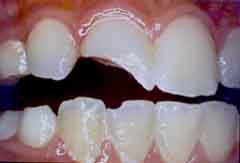
Chipped or broken teeth: 
Save any pieces. Rinse the mouth using warm water; rinse any broken pieces. If there's bleeding, apply a piece of gauze to the area for about 10 minutes or until the bleeding stops. Apply a cold compress to the outside of the mouth, cheek, or lip near the broken/chipped tooth to keep any swelling down and relieve pain. Take ibuprofen, not aspirin, for pain. Your dentist can smooth out minor fractures with a sandpaper disc. Alternatively, restorative procedures may be needed to fix the tooth.
 Tooth Chips on Denture

If you wear dentures and a tooth breaks or chips, wear your spare dentures until you can visit your dentist. If you do not have a spare set or cannot get to the dentist's office soon, use cyanoacrylate (heavy-duty, quick-drying "super" glue) to glue the tooth or the piece of the tooth back into place. Remember—this is only a temporary measure until your dentist can properly repair your tooth and should only be used for dentures! Never attempt to glue a natural tooth or part of a natural tooth back into place!

Knocked-out tooth
 Retrieve the tooth, hold it by the crown (the part that is usually exposed in the mouth), and rinse off the tooth root with water if it's dirty. Do not scrub it or remove any attached tissue fragments. If possible, try to put the tooth back in place. Make sure it's facing the right way. Never force it into the socket. If it's not possible to reinsert the tooth in the socket, put the tooth in a small container of milk (or cup of water that contains a pinch of table salt, if milk is not available) or a product containing cell growth medium, such as Save-a-Tooth. In all cases, see your dentist as quickly as possible. Knocked out teeth with the highest chances of being saved are those seen by the dentist and returned to their socket within 1 hour of being knocked out.

 Extruded (partially dislodged) tooth
See your dentist right away. Until you reach your dentist's office, to relieve pain, apply a cold compress to the outside of the mouth or cheek in the affected area. Take an over-the-counter pain reliever (such as Tylenol or Advil) if needed.

 Objects caught between teeth
First, try using dental floss to very gently and carefully remove the object. If you can't get the object out, see your dentist. Never use a pin or other sharp object to poke at the stuck object. These instruments can cut your gums or scratch your tooth surface.

Lost filling
As a temporary measure, stick a piece of sugarless gum into the cavity (sugar-filled gum will cause pain) or use an over-the-counter dental cement. Then See Your Dentist immediately!!
       
Lost crown.
If the crown falls off, make an appointment to see your dentist as soon as possible and bring the crown with you. If you can't get to the dentist right away and the tooth is causing pain, use a cotton swab to apply a little clove oil to the sensitive area (clove oil can be purchased at your local drug store or in the spice aisle of your grocery store). If possible, slip the crown back over the tooth. Before doing so, coat the inner surface with an over-the-counter dental cement, toothpaste, or denture adhesive, to help hold the crown in place. Do not use super glue!

 Broken braces and wires
If a wire breaks or sticks out of a bracket or band and is poking your cheek, tongue, or gum, try using the eraser end of a pencil to push the wire into a more comfortable position. If you can't reposition the wire, cover the end with orthodontic wax, a small cotton ball, or piece of gauze until you can get to your orthodontist's office. Never cut the wire, as you could end up swallowing it or breathing it into your lungs.
 Loose brackets and bands
Temporarily reattach loose braces with a small piece of orthodontic wax. Alternatively, place the wax over the braces to provide a cushion. See your orthodontist as soon as possible. If the problem is a loose band, save it and call your orthodontist for an appointment to have it recemented or replaced (and to have missing spacers replaced).

 Abscess
Abscesses are infections that occur around the root of a tooth or in the space between the teeth and gums. Abscesses are a serious condition that can damage tissue and surrounding teeth, with the infection possibly spreading to other parts of the body if left untreated.

 Because of the serious oral health and general health problems that can result from an abscess, see your dentist as soon as possible if you discover a pimple-like swelling on your gum that usually is painful. In the meantime, to ease the pain and draw the pus toward the surface, try rinsing your mouth with a mild salt water solution (1/2 teaspoon of table salt in 8 ounces of water) several times a day.


 Soft-tissue injuries and Bleeding
Injuries to the soft tissues, which include the tongue, cheeks, gums, and lips, can result in bleeding. To control the bleeding, here's what to do:


Rinse your mouth with a mild salt-water solution.
  1. Use a moistened piece of gauze or tea bag to apply pressure to the bleeding site. Hold in place for  15 to 20 minutes.
  2. To both control bleeding and relieve pain, hold a cold compress to the outside of the mouth or cheek in the affected area for 5 to 10 minutes.
  3. If the bleeding doesn't stop, see your dentist right away or go to a hospital emergency room. Continue to apply pressure on the bleeding site with the gauze until you can be seen and treated.
Cavity Calming Solutions: Applying ice (on and off) to the affected area or to the cheek may help sooth irritated nerves and reduce swelling. Oil of cloves (from the pharmacy), or even fresh cloves from the spice rack, have been known as an aid in relieving pain naturally. Never place an aspirin directly on a painful area inside the mouth.


We often say the mouth is the gateway to total wellness. Treat your mouth with respect and care, including eating a healthy, antioxidant-rich diet, and exercising and brushing three times a day. Visit your dentist regularly for cleanings and oral health exams. Your dentist may be able to prevent a possible emergency by catching dental problems before they begin - saving you a lot of discomfort and a potential emergency visit later. And common dental issues, such as gum disease, may be precursors to other, more serious illnesses. Studies from Harvard and other major medical institutions have proven that poor gums can put you at high risk for diabetes, heart disease and other illness.


Many people see their dentist more than they see any other doctor. If you are like many who are afraid to see the dentist regularly, ask about "pain free" dental care. Today's dental science has come a long way - and patients should not be afraid to seek good oral health options. If you are concerned because you do not have insurance, talk to your dentist about possible payment options or other forms of help that may be available.
Work Cited
WebMD